
Breaking the cycle of disease and poverty
Our global health bioinformatics training initiative uses private donations to fund free and reduced price bioinformatics training sessions to researchers in critical global health care settings. Poverty causes disease, and disease causes poverty. Resource constrained nations face a critical need for training in data analysis techniques in order to effectively combat disease. By providing this training, we equip public health researchers to quickly analyze datasets, allowing them to provide timely guidance that leads to more effective disease control. This in turn allows healthy people to return to work, relieving poverty.
Malaria Research
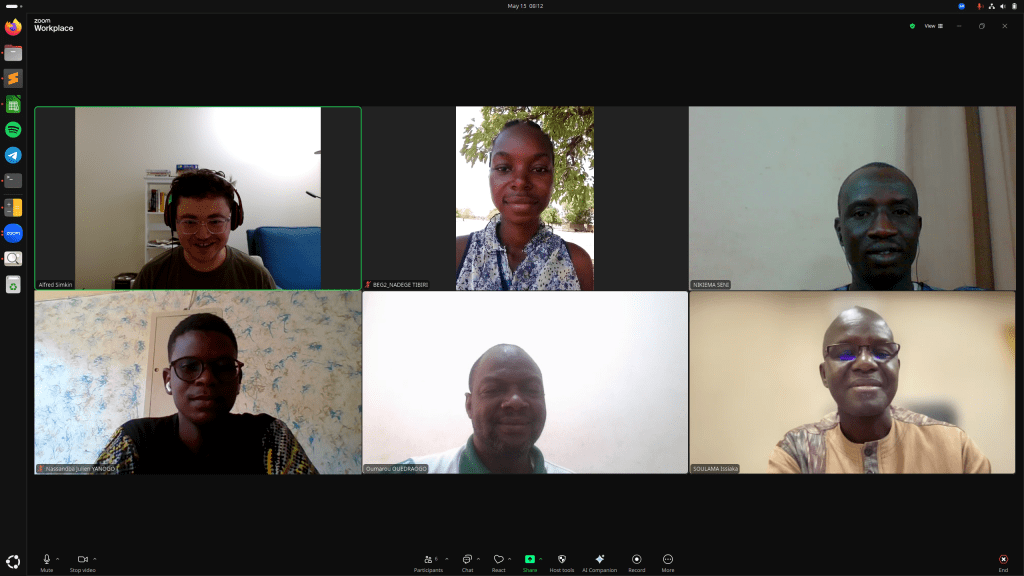
At the moment, we are focusing mainly on malaria. Malaria is one of the main drivers of disease in sub-Saharan Africa, and we already have existing relationships with several malaria public health teams. Using a small amount of seed funds from private donors, funding from the Gates Foundation, and our own donated time, we have established training relationships with malaria researchers in Tanzania, Burkina Faso, Ethiopia, and Uganda.
We have had strong success in training researchers associated with the molecular surveillance of malaria in Tanzania (MSMT) – walking them through the process of analyzing thousands of samples taken from across the country – and at the Ethiopian Public Health Institute (EPHI), where we have trained users in analyzing amplicon sequencing data for recent outbreaks of schistosomiasis and malaria. We are in the process of establishing additional training relationships with researchers in Ghana, Cameroon, Rwanda, and the Democratic Republic of the Congo.
Disease directly pulls sickened people out of the labor force, pulls healthy people out of work to assume care-giving responsibilities, and makes it difficult for everyone else to obtain basic services. Public health is essential to a functioning economy, and training in data analysis techniques directly contributes to effective public health policy.
Our Approach
We aim to establish close working personal relationships with key global health research organizations. Similarly to our personalized consulting approach, we believe what sets us apart is our focus on person-centered learning. Rather than focusing on a specific bioinformatics course or attempting to write code that addresses a specific research question, we let the teams we meet with guide the training we provide. We meet with students and researchers who have an interest in bioinformatics to learn their current workflows, skill level, and research questions. We offer three main services: First, we conduct one-on-one and small group sessions to learn current skills and research needs, and we train people on any skill gaps that we identify. Second, when our clients require solutions that aren’t ready-made, we use collaborative programming to help researchers create customized and automated pipelines for quick data analysis, teaching them in the process how to re-create these types of pipelines. Third, we establish connections between researchers working on similar topics – creating links between teams and communities of practice around popular topics such as data visualization.
As researchers become more proficient, we make introductions and encourage people to begin training each other, producing an exponential increase in our impact. In this way, we hope to eventually saturate the public health space with proficient bioinformatics researchers who can quickly and efficiently analyze large datasets, thus preventing disease, increasing economic output, and breaking the cycle of poverty and illness.
How You Can Help
We are actively looking for donors and funders – Our reduced rate for global health researchers is $80/hour and any donation can have a large impact. A recent donation of $2,000 from a very generous donor is paying for 25 hours worth of training sessions for global health researchers. Our model is a very cost-effective way to give an entire research team the skills needed for self-sufficiency and improved public health. As few as 5 hours’ worth of training can often be enough to equip a relatively proficient team with a few key missing tools needed to answer a wide range of related global health questions, and 20 hours (interspersed over several weeks with a lot of self-directed practice) can be enough to train a novice in basic programming techniques. Donations of any amount will be used to contribute to this pool of available training time.
We are also looking for ways to collaborate and expand our impact. If you would like to get involved, you can reach out to us at boxwoodbioinformatics@gmail.com
Make a one-time donation
Make a monthly donation
Make a yearly donation
Choose an amount
Or enter a custom amount
Your contribution is appreciated.
Your contribution is appreciated.
Your contribution is appreciated.
DonateDonate monthlyDonate yearly Boxwood Bioinformatics